What Is a ‘Domestic Archipelago’? Inside Portugal’s Most Unusual New Home Development
Most new residential developments start with a floor plan. Apaulinha starts with a question: how do nine households share one landscape without losing their privacy?
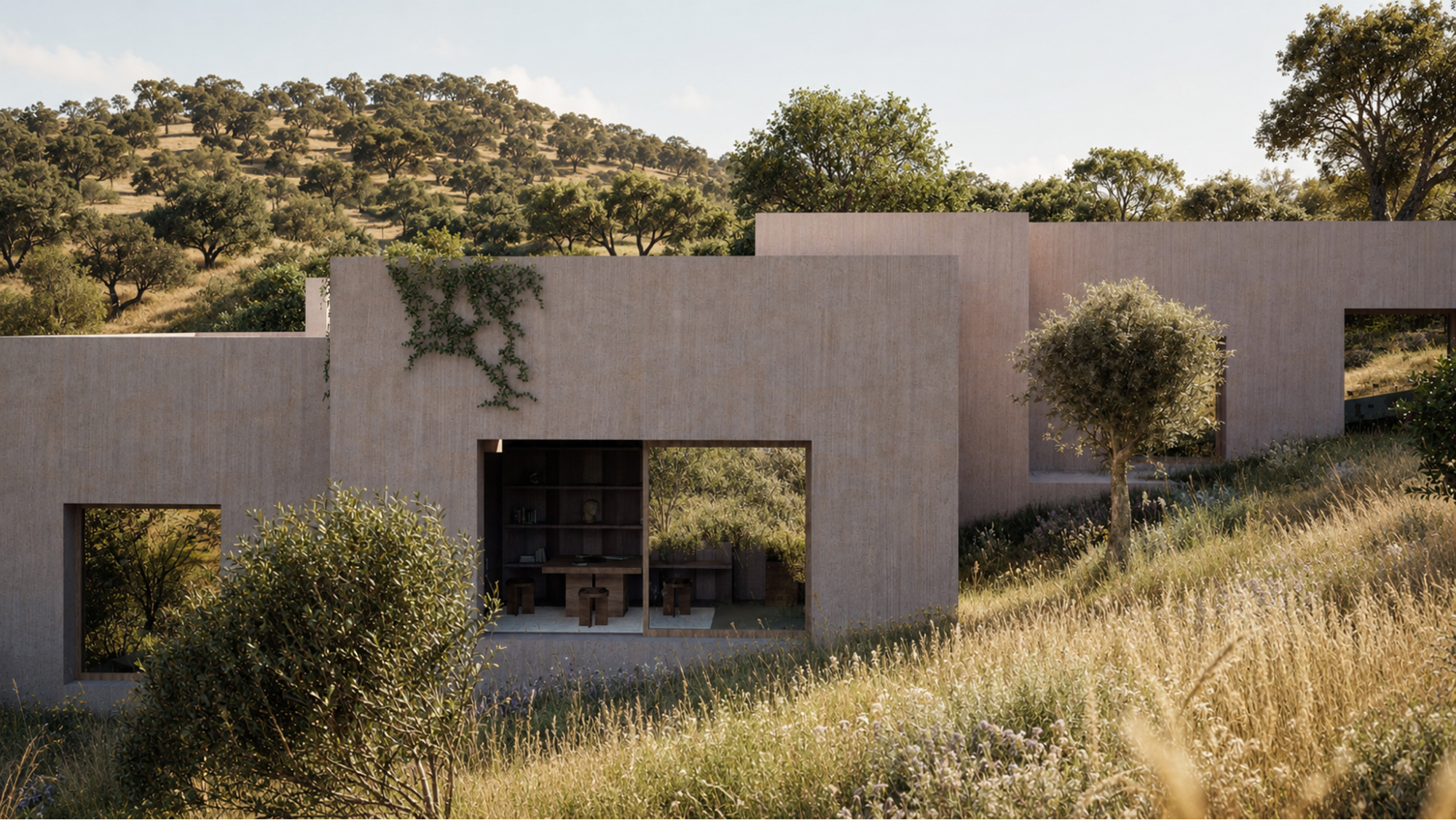
The answer, now taking shape on Portugal’s Alentejo coast near Melides, is a private residential domain spread across 12.5 hectares of cork-oak forest. Rather than a row of near-identical villas, Apaulinha comprises eight newly designed houses plus one original farmhouse, each set on more than a hectare of land and each architecturally distinct. The practice behind it, Policronica Studio, working with Julien Labrousse and Ambre Babzoe Marazzi, avoided the template approach altogether: no two houses share the same footprint, orientation or materials palette, though all draw on the same vocabulary of stone, timber, natural light and cross-ventilation between indoors and out.
Inside, the brief was for houses that feel calm rather than showy: deep overhangs for shade, openings framed toward a specific view or courtyard rather than a generic wall of glass, and a restrained material palette that ages well in a coastal climate. It is a quieter kind of architecture than the glass-box villas that often define modern in property listings.
For anyone weighing up a second home abroad, the interesting part isn’t the architecture alone, it’s what happens between the houses. Apaulinha’s shared spaces are deliberately modest and spread out rather than concentrated in one big clubhouse: a central lake for swimming and gathering, a thermal room pairing a timber sauna with a cold plunge, a low-key movement room in place of a conventional gym, a court, a children’s studio, and a partly buried night room and bar known as The Shelter. The idea is to make encounters between neighbours possible without making community compulsory; privacy remains the starting point of each house.
That balance matters for buyers who like the idea of a second home but not the upkeep. Apaulinha is run as what its developers describe as between home and hotel: a dedicated team handles rentals, housekeeping, storage and arrival preparation, so an owner’s week at the house doesn’t start with jobs. It’s a model more second-home buyers are asking for, as the idea of a static holiday house gives way to a flexible base that can also earn its keep when the family isn’t there.
Location is doing a lot of the work, too. Melides sits inland from the Alentejo’s Atlantic coastline, in the same stretch of countryside as Comporta and Grandola, an area known for cork oak forests, quiet beaches and a slower pace than the Algarve further south. Lisbon is around 70 minutes away by car, which keeps the location realistic for owners who want a proper change of pace without a full day of travel to get there.
Construction on Apaulinha is scheduled to begin in October 2026, with completion targeted for 2028. A limited pre-launch release of three of the nine residences is available now by reservation, ahead of the wider release. The project is developed by Apaulinha – Elegant Horizon Lda, backed by Groupe Deleuze, a French holding company with two decades of experience in residential development, hospitality and architecture across France, Portugal and Spain.
For UK buyers used to thinking of a second home as either a French gite or a Spanish apartment block, Apaulinha is a reminder that Portugal’s Alentejo coast is quietly building an alternative: fewer houses, more land around each one, and a shared landscape designed to do some of the work a hotel normally would.