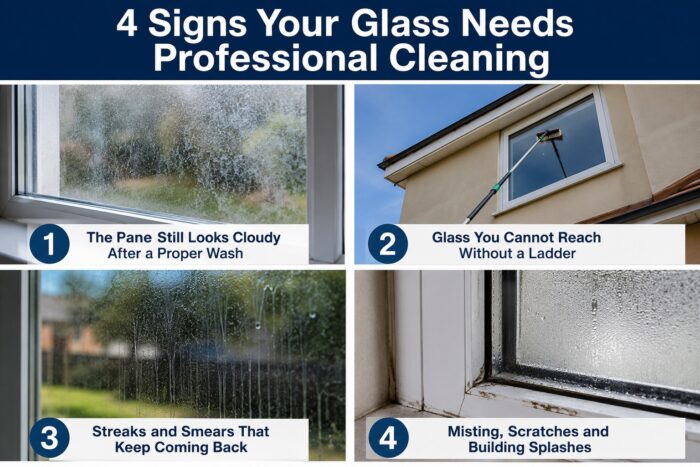
4 Signs Your Glass Needs Professional Cleaning
Introduction
Windows have a way of getting worse in slow motion. You clean them, they look grand for a fortnight, then the haze creeps back and you start wondering whether it’s the glass or the cloth. Most of the time a bucket, a squeegee and a cool morning are all you need. But there’s a point where more scrubbing stops helping, and pushing on past it just wastes a Saturday or risks a nasty fall. Here are four signs that the glass around your home has gone beyond a DIY wash, what’s worth trying before you give up on it, and roughly what the professional fix costs.
The Pane Still Looks Cloudy After a Proper Wash
You’ve washed it twice, dried it with a clean cloth, and there’s still a milky bloom across the middle. That’s the clearest signal the problem isn’t surface dirt any more. Hard water covers most of England, and every drop that dries on a pane leaves a little calcium and magnesium behind. Layer by layer, those minerals bond to the surface instead of resting on it.
Give it a few years and the crust starts to bite in. Limescale slowly etches the glass, leaving microscopic pits that scatter light — which is why old conservatory panels, patio doors and shower screens go permanently dull while the frames still look perfectly fine.
There’s a simple test worth doing first. Mix white vinegar one part to four with warm water, or stir a spoon of citric acid into a cup of hot water. Soak a cloth, lay it flat on the worst patch and leave it ten minutes. If the haze lifts, brilliant — repeat and rinse well. If it doesn’t budge, it’s bonded on, and no amount of elbow grease will change that. Restoration is the answer: a specialist machine-polishes the glass with cerium oxide, priced per pane from about £15 to £40.
Glass You Cannot Reach Without a Ladder
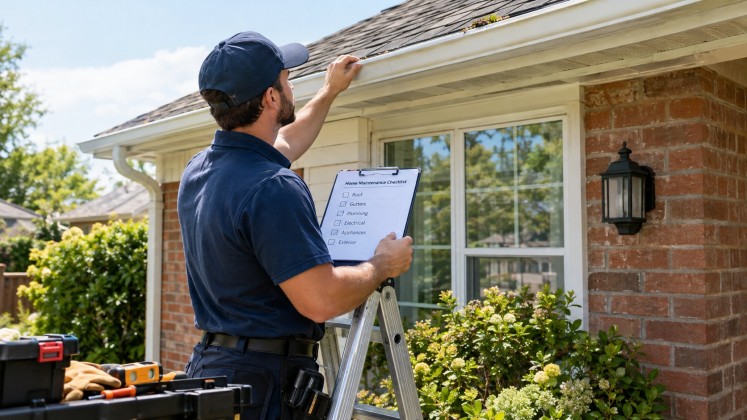
Some windows are simply out of bounds. The upper-floor bedrooms, the pane above a conservatory roof, the tall one over the stairwell, anything above a flat roof or an extension. These stay grubby for years, because there’s no sensible way to get at them.
Please treat this one seriously. Falls from height are among the most common causes of serious injury around the home, and ladders are behind most of them. A ladder on a lawn, a flower bed or wet paving has almost no grip, and soft ground gives way under one foot without warning. Stretching sideways for the last few inches is what tips people off. If you find yourself leaning, climb down and move the ladder — or leave that pane alone.
The honest DIY check is this: stand at ground level and work out what you can wash with both feet planted. An extendable pole with a soft head will get you 10 to 12 feet up in comfort, which covers most ground-floor glass and a porch. Past that, a window cleaning service with a water-fed pole handles three or four storeys from the ground with nobody off the floor. A terraced or semi-detached exterior clean runs £20 to £45.
Streaks and Smears That Keep Coming Back
If your windows look perfect while wet and dreadful once dry, the kit and the water are usually at fault rather than the glass. Washing-up liquid is the main offender. It’s full of salts and skin conditioners that dry into a faint smeary film, and every wash adds another coat — the same reason a kitchen splashback often ends up hazier than the window above the sink.
Sunshine is the next culprit. On a hot pane the solution flashes off before your squeegee arrives, so the dirt dries straight back where it was. Work an overcast morning, or follow the shade round the house. Check the blade too, because a nick or a rounded edge leaves a hairline exactly where you’ll notice it, and a fresh one costs a couple of pounds. A cloth already loaded with grease only spreads it about, so rinse or swap it often.
Then there’s the water itself. Ordinary tap water dries with its minerals still sitting on the glass, and that’s where the faint mist comes from. Professionals filter theirs down to deionised or purified water — nothing dissolved in it, so nothing is left behind when it dries. No squeegee marks, no spotting, and the finish stays clear for weeks instead of days. Inside and out together costs £50 to £90.
Misting, Scratches and Building Splashes
Sometimes what you’re squinting at isn’t dirt at all. When a double-glazed unit turns cloudy between the panes, or holds a tidemark you can’t reach from either side, the seal has failed and damp air is inside the unit. No cleaner can get in there. That one needs the sealed unit replaced, roughly £150 to £400 a window, and it’s a glazier’s job rather than a cleaner’s.
A scratch splits the same way. Run a fingernail across it — if it catches, the glass is gouged and only replacement will do. If it doesn’t, it’s probably grit dragged under a cloth, and a polish will often take it out.
Plenty of other marks look permanent and aren’t. Paint flecks, render, cement dust and builders’ silicone all come off once they’re softened and lifted with a blade held flat under plenty of lubrication. Green algae and black spotting in the frame corners and seals is more stubborn, because it feeds on damp trapped in the rubber. Bicarbonate paste or a mould spray left ten minutes usually shifts it.
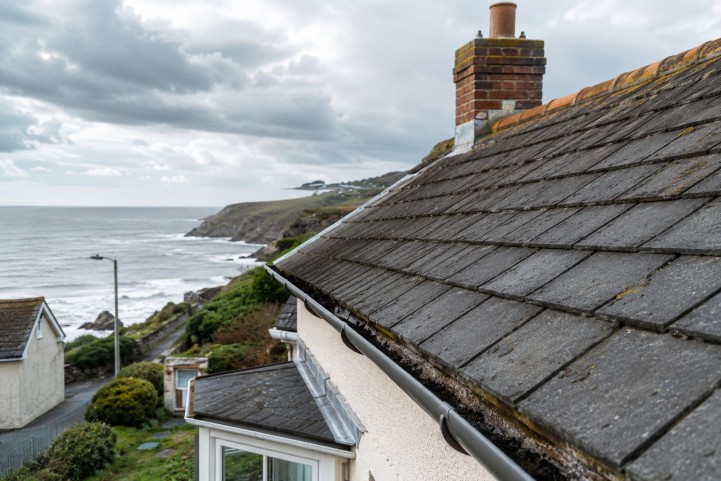
If it’s back within weeks, an overflowing gutter above is often the cause, so gutter cleaning is worth booking alongside. Frames and sills come as part of a full clean, conservatory roofs start around £60, and after building work a one-off deep cleaning visit clears the lot in one go.
Conclusion
Four signals, then. Washing changes nothing, you can’t get to it safely, the streaks keep returning, or something has appeared that isn’t dirt. The first and third are often fixable with vinegar, a new blade and a cool morning, so they’re well worth an hour of your time. The other two rarely are. Have a proper look round the house this weekend, try the vinegar dwell test on your haziest pane, and if it won’t budge — or it’s well above head height — book a window cleaning service rather than another spray bottle.