
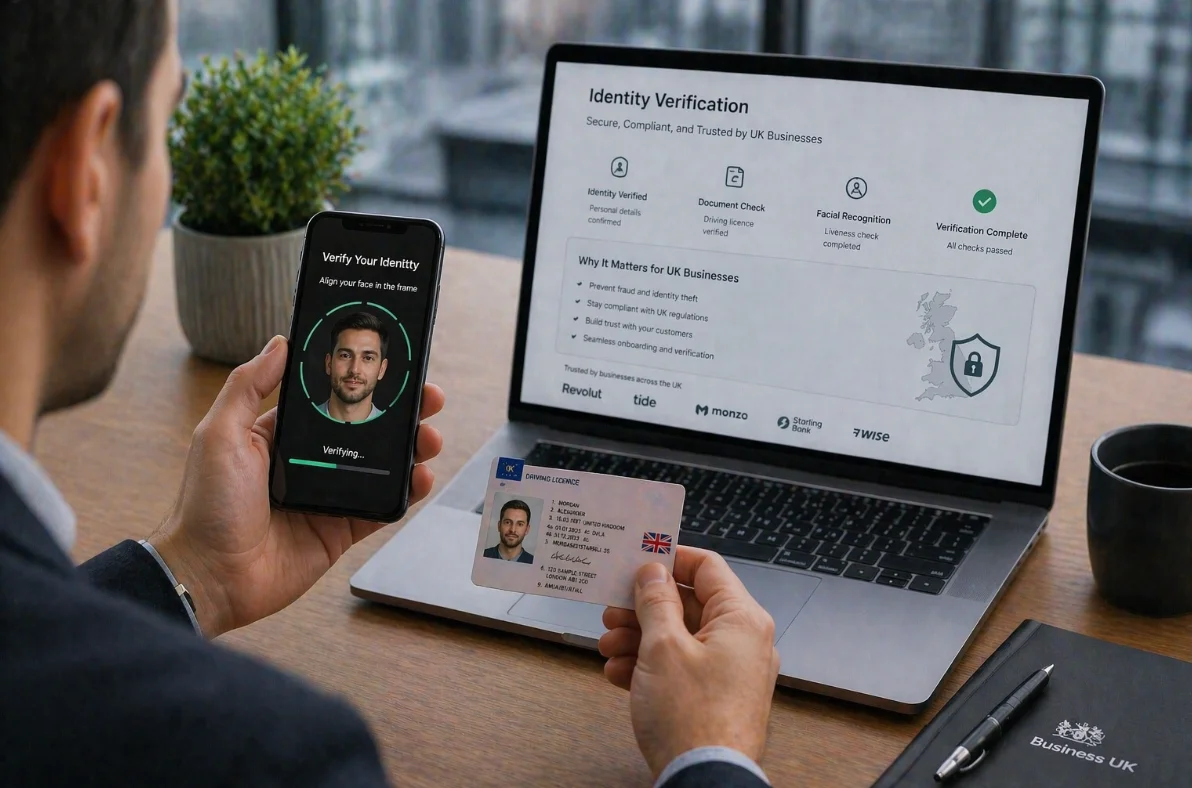
Identity Verification Explained: What It Is, Why It Matters, and How UK Businesses Are Using It
There is a question that sits quietly behind almost every online interaction where money, data, or access is involved: Is this person really who they say they are? For most of us, it feels invisible. You upload a photo of your passport, take a selfie, and moments later, you are approved and on your way. But behind that smooth experience sits an entire industry built around one of the most important problems in modern business: confirming identity accurately, quickly, and securely.
Identity verification is now embedded into everyday life in the UK. Whether you are opening a new bank account, registering with a cryptocurrency exchange, applying for a credit card, or even renting a flat, your identity is being checked in ways that would have felt futuristic a decade ago. And as fraud becomes more sophisticated and regulations tighten, both businesses and consumers have a growing stake in understanding how this technology works and why it has become so essential.
What Is Identity Verification?
Identity verification often shortened to IDV is the process of confirming that a person is genuinely who they claim to be. In simple terms, it answers the question: Does the identity being presented actually belong to the individual presenting it?
Traditionally, this was done face-to-face. A bank teller would check your passport, compare your face to the photograph, and note down your details by hand. The process was slow, inconsistent, and entirely dependent on human judgment. If a forged document was convincing enough, it could easily slip through.
Today, digital identity verification has transformed this process entirely. Using a combination of artificial intelligence, document analysis, biometric technology, and real-time database checks, businesses can now verify a customer’s identity online in under two minutes, often with a higher degree of accuracy than any human could achieve. A modern identity verification platform does not simply look at whether a document appears genuine. It examines hundreds of micro-details simultaneously: font consistency, document structure, chip data, holographic features, and the match between the person’s live face and the photograph on file.
This shift from manual to digital is not just about speed. It is about creating a consistent, auditable process that holds up under regulatory scrutiny and scales to meet the demands of a business serving thousands or millions of customers.
Why Identity Verification Matters Right Now
Identity fraud in the UK has become one of the fastest-growing categories of financial crime. According to industry data, hundreds of thousands of identity fraud cases are reported every year, with losses running into billions of pounds. The individuals behind these crimes are not always sophisticated hackers working from underground servers increasingly, they are opportunists armed with basic editing tools and stolen personal data obtained from data breaches.
One of the most common tools of identity fraud is the fake ID. A forged or digitally manipulated identity document, submitted during an online onboarding process, can be enough to open a fraudulent account, access credit, or launder money through a legitimate platform. In a fully digital environment where no human physically inspects the document, the window for this kind of fraud is wide open unless robust identity verification services are in place.
The consequences for businesses that fail to catch these attempts are significant. Beyond the direct financial losses, there are regulatory penalties, reputational damage, and in serious cases, criminal liability. For any business operating in a regulated sector, failing to verify customer identity is not just a security failure it is a compliance failure with consequences that can threaten the business itself.
At the same time, from the customer’s point of view, poor identity verification creates a different kind of risk. When fraudsters successfully impersonate individuals, the victims can spend months sometimes years untangling the damage done to their credit records and financial accounts. A strong identity verification solution protects not just the business, but the people it serves.
How Identity Verification Works in Practice
Understanding the mechanics of modern IDV helps explain why businesses are investing in it so heavily. The process is layered, with each stage adding a level of confidence to the outcome.
Document Verification
The first stage is the capture and analysis of an identity document most commonly a UK passport, driving licence, or national identity card. The user submits a photograph or scan of the document through a web or mobile interface. From there, identity verification software goes to work.
The system applies optical character recognition to extract the readable data on the document name, date of birth, document number, expiry date and then runs a detailed authenticity check on the image itself. This involves comparing the document against known templates, checking for signs of digital manipulation, verifying the Machine Readable Zone (MRZ) data, and assessing security features such as holograms and watermarks. A document that passes these checks has cleared the first major hurdle.
Biometric Matching
Once the document is verified, the process moves to confirming that the person submitting the document is its rightful owner. The user is asked to provide a live selfie or complete a short facial movement task turning their head, blinking, or speaking a phrase. The system uses facial recognition technology to compare this live image with the photograph embedded in the document.
This stage also applies liveness detection, a technology designed to distinguish a real, present person from a static image or video replay. With the rise of deepfake technology and AI-generated imagery, liveness detection has become an increasingly critical component of any serious ID verification solution. The best systems in this space can detect fraudulent attempts with a high degree of reliability, even when the fake is convincingly produced.
Database Cross-Referencing
The final layer involves checking the extracted identity data against authoritative third-party databases. Depending on the nature of the business and its regulatory obligations, this may include electoral roll records, credit reference data, sanctions lists, Politically Exposed Person (PEP) databases, and adverse media sources.
This stage is what allows businesses to go beyond simply confirming that a document is real and a face matches a photo. It confirms that the identity itself the person behind the document is who they present themselves to be, and that there are no red flags that should prevent a business relationship from proceeding.
Where Identity Verification Is Being Used
The range of industries adopting identity verification services has expanded considerably as digital transformation has touched every corner of the economy.
- Financial services and fintech: Banks, building societies, digital lenders, and payment platforms all operate under strict Know Your Customer (KYC) obligations. For these businesses, an ID verification tool is not optional it is a regulatory necessity built into the onboarding process.
- Cryptocurrency and digital assets: Crypto exchanges and wallet providers are now subject to the same AML regulations as traditional financial institutions. Digital identity verification is central to their compliance frameworks.
- Online gambling: Licensed gambling operators in the UK must verify the age and identity of every player before they can deposit or bet. IDV automates this check without creating friction that drives users away.
- Property and lettings: Landlords and letting agents must comply with Right to Rent legislation, confirming a tenant’s immigration status and identity before granting access to a property. Digital IDV has made this process faster and more reliable.
- Healthcare: Telehealth and online prescription platforms use identity checks to confirm patient identity, preventing the misuse of medical services and protecting patient safety.
- HR and recruitment: Employers must verify right-to-work documentation for every new employee. Remote hiring has made the digital approach the practical standard.
The Regulatory Picture: What UK Businesses Need to Know
For UK businesses, the regulatory landscape around identity verification is both clear and demanding. The Financial Conduct Authority sits at the centre of this picture for regulated financial firms, requiring them to implement proportionate, risk-based KYC checks as part of their Anti-Money Laundering (AML) obligations. The Money Laundering, Terrorist Financing and Transfer of Funds Regulations 2017 set out the legal framework, with firms required to verify customer identity before establishing a business relationship and to apply enhanced due diligence where the risk is higher.
The Financial Conduct Authority does not prescribe exactly how verification must be carried out but it does expect firms to be able to demonstrate that their processes are robust, consistent, and proportionate to the risks involved. This means that a business relying on manual document checks alone, without any systematic digital verification, would struggle to satisfy a regulatory review.
Beyond financial services, the Information Commissioner’s Office (ICO) governs how biometric and personal data collected during identity checks must be handled under UK GDPR. Any business processing facial images or document data must have a clear legal basis for doing so, appropriate data minimisation policies, and a defined retention schedule. Selecting an identity verification platform that is designed with GDPR compliance built in significantly reduces this compliance burden.
The UK government is also moving towards a formal digital identity framework. The Data (Use and Access) Act sets the foundation for a system in which verified digital identities can be shared and reused across services, reducing duplication for consumers and creating a more trusted, standardised approach to identity across both public and private sectors.
How Businesses Are Adopting Identity Verification
Adopting an identity verification solution typically follows one of two paths. Larger enterprises often build bespoke workflows around an Identity Verification API provided by a specialist vendor, integrating the checks directly into their own platforms and customer journeys. This approach gives maximum flexibility checks can be triggered at specific points in the journey, customised for different risk levels, and the results fed directly into internal case management systems.
Smaller businesses often opt for a more plug-and-play approach, using identity verification software that comes with a ready-built interface and minimal integration effort required. For a startup or growing SME that needs to launch quickly and maintain compliance from day one, this kind of solution offers a practical balance between capability and cost.
Across both approaches, the factors that matter most when choosing a provider are accuracy rates, the breadth of document types supported, the sophistication of the liveness detection, the strength of the compliance coverage, and the quality of the supporting documentation and customer service. A provider that offers a genuinely global identity verification platform capable of checking documents from dozens of countries will serve a UK business with an international customer base far better than one focused solely on domestic documents.
Conclusion
Identity verification is one of those technologies that most people encounter regularly without ever thinking much about it. But the systems working behind the scenes checking documents, matching faces, screening watchlists, and creating audit trails represent a significant and growing area of business investment and regulatory focus in the UK.
For businesses, the choice is increasingly not whether to implement digital identity verification, but how to do it well. Getting it right means faster, safer customer onboarding, stronger protection against fraud, and confident compliance with the rules set out by the Financial Conduct Authority and other regulators. Getting it wrong or not doing it at all means exposure to fraud, regulatory risk, and the reputational cost that comes with both.In a landscape where a convincing fake ID can be produced with consumer software and a stolen photograph, the businesses that invest in rigorous, technology-driven identity verification are the ones that will be trusted by their customers and their regulators alike.

Karen Altizer is a seasoned professional with a wealth of experience, skilled at crafting compelling narratives and strategic messages for diverse audiences.